Condition Focus
Hip Labral Tear Repair & Reconstruction
Repair and reconstruction of the acetabular labrum for Cincinnati athletes and active adults — restoring the hip's suction seal, stability, and pain-free motion.
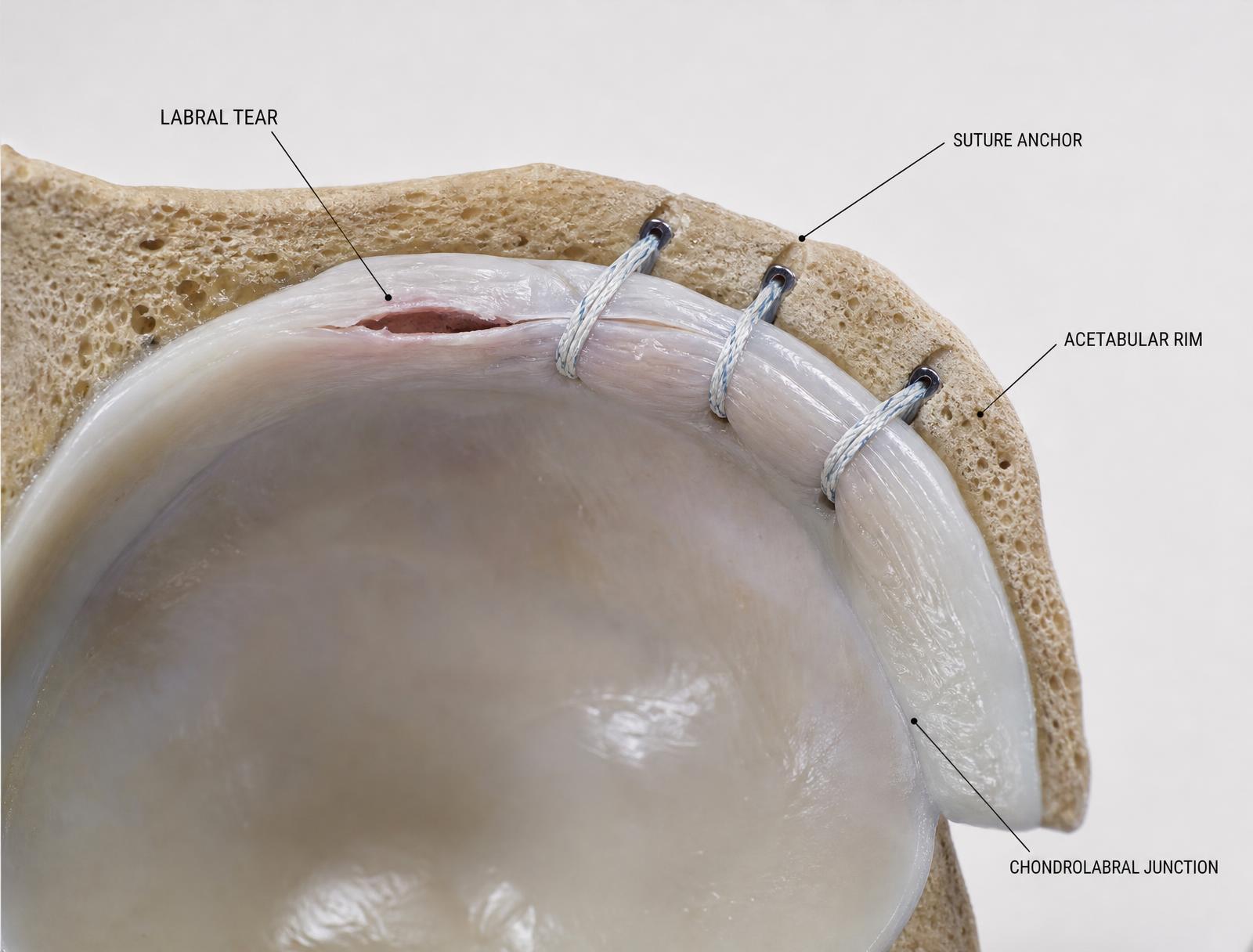
The acetabular labrum is a ring of fibrocartilage that deepens the socket and creates a fluid seal around the femoral head. When it tears — most often from femoroacetabular impingement, dysplasia, or a rotational injury — the seal is lost, load transfers unevenly onto cartilage, and the hip can feel sharp, catching pain in the groin.
Where tissue quality allows, the labrum is repaired anatomically with suture anchors placed along the acetabular rim. Where the labrum is calcified, ossified, or deficient from prior surgery, segmental or circumferential reconstruction with graft tissue restores the seal.
Symptoms & findings
- /Sharp or catching groin pain with pivoting, deep flexion, or getting out of a car
- /Clicking, locking, or a giving-way sensation in the hip
- /Pain with prolonged sitting or driving
- /Night pain or aching after activity
- /A sense that the hip does not feel 'seated' or secure
Diagnostic approach
Diagnosis combines a hip-specific examination with impingement and instability testing, standing radiographs to assess the bony morphology that caused the tear, and MRI or MR arthrography to define the tear pattern and tissue quality. Diagnostic intra-articular injection can confirm that the pain is coming from inside the joint.
Treatment options
Non-operative management
Activity modification, targeted physical therapy for hip and core control, and selective injections can settle symptoms in low-demand patients or small stable tears — particularly when there is no significant bony impingement driving the tear.
Arthroscopic labral repair
Suture anchors are placed in the acetabular rim and the labrum is reapproximated to bone in an anatomic, seal-restoring position. Any cam or pincer bone that caused the tear is corrected in the same procedure, and the capsule is closed to protect stability.
Labral reconstruction
When native tissue is irreparable — hypoplastic, ossified, or failed after prior surgery — graft tissue is used to rebuild the labrum segmentally or circumferentially, re-establishing the fluid seal and negative intra-articular pressure.
Why patients see Dr. Almasri in Cincinnati
- /Dual fellowship training in hip preservation surgery and orthopedic sports medicine
- /Practice strongly focused on the young and active hip
- /Team physician experience with FC Cincinnati and regional collegiate programs
- /Peer-reviewed research and international faculty roles in hip preservation
- /In-office and direct online scheduling through Mercy Health