Condition Focus
Hip Instability & Dysplasia
Periacetabular osteotomy, microinstability stabilization, and capsular reconstruction for the shallow, lax, hypermobile, or microunstable hip.
Hip instability ranges from frank structural dysplasia — a socket too shallow to cover the femoral head — to subtle microinstability in dancers and rotational athletes, and to hypermobility-related disorders such as generalized joint laxity, hypermobile Ehlers-Danlos syndrome (hEDS), and hypermobility spectrum disorder.
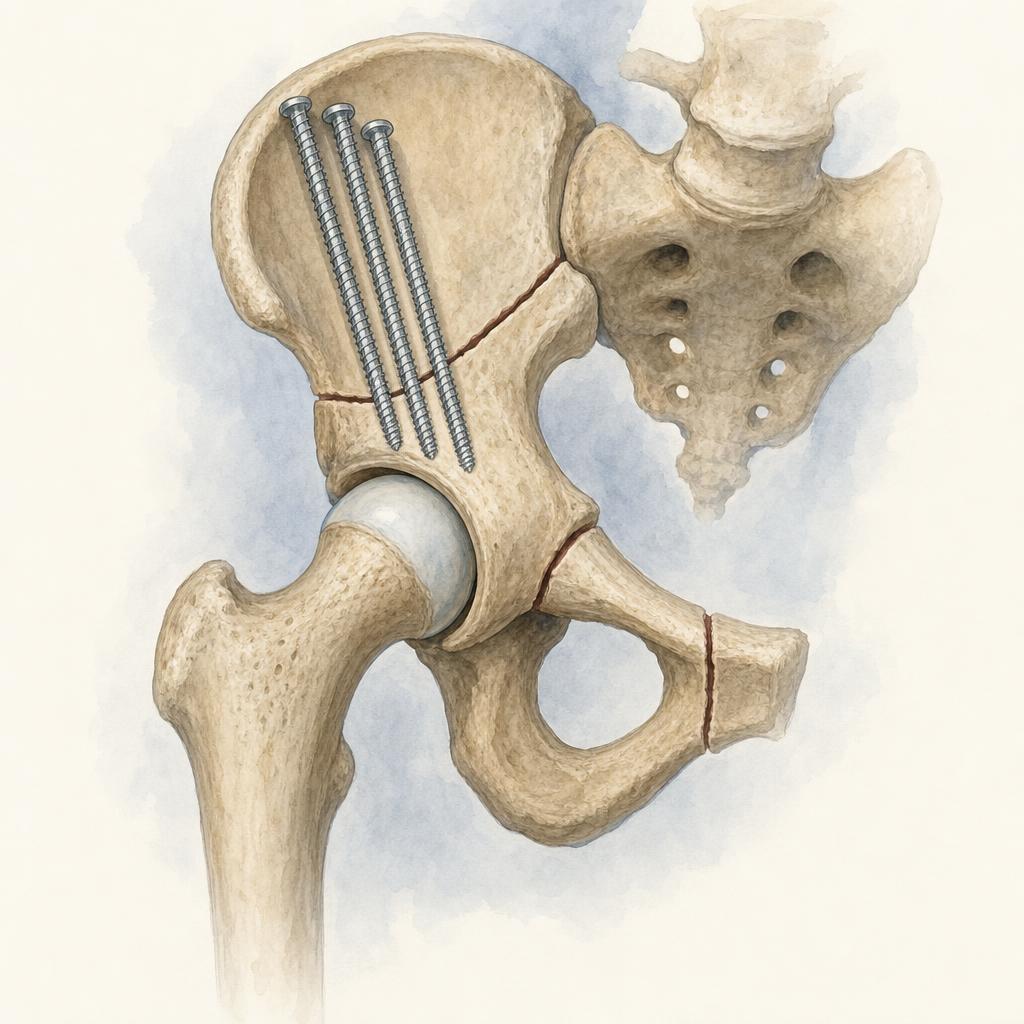
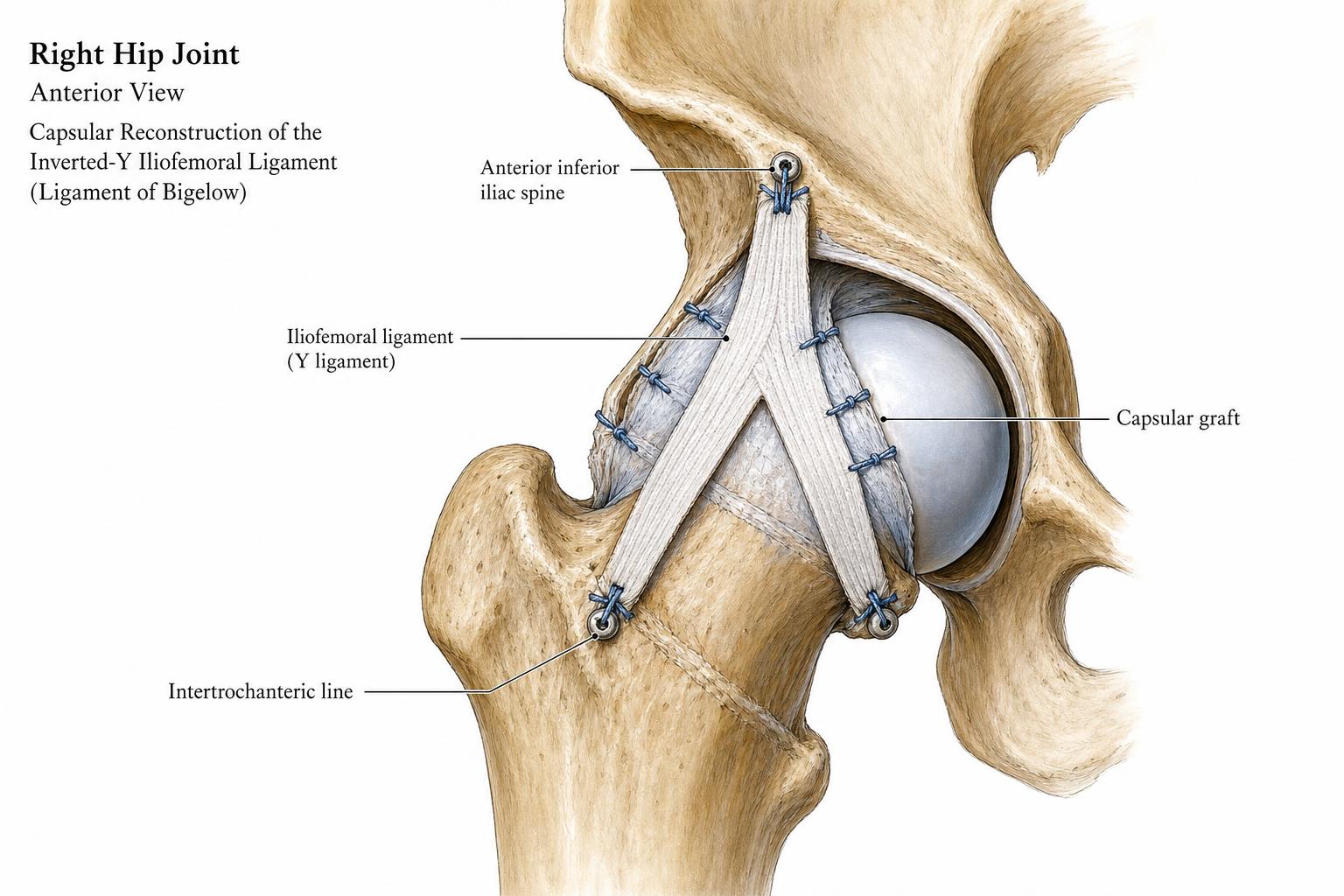
In a shallow socket, load concentrates on a small strip of cartilage at the rim and arthritis follows. Periacetabular osteotomy (PAO) reorients the acetabulum over the femoral head to provide durable coverage. Where bony coverage is adequate but the soft-tissue restraints are deficient, labral repair with capsular plication restores the seal and rotational control. When the capsule is irreparably deficient or has failed after prior surgery, capsular reconstruction rebuilds the iliofemoral ligament with graft tissue.
Symptoms & findings
- /Groin or lateral hip pain that worsens with standing, walking, or end-range motion
- /A feeling that the hip shifts, slips, or gives way
- /Fatigue-type aching in the hip abductors after activity
- /Pain with extension and external rotation — the 'at-risk' position for dancers
- /History of generalized joint hypermobility or dislocations elsewhere
Diagnostic approach
Evaluation includes standing AP pelvis and false-profile radiographs to measure lateral center-edge angle, anterior coverage, and acetabular inclination; MRI to assess the labrum, cartilage, and capsule; and where indicated CT with version analysis. Beighton scoring is used to identify generalized laxity and guide a laxity-adjusted treatment plan.
Treatment options
Periacetabular osteotomy (PAO)
For structural dysplasia, the acetabulum is freed with a series of controlled cuts and rotated over the femoral head to normalize coverage, then fixed with long screws. PAO redistributes joint load and is the most reliable way to delay or prevent arthritis in a young dysplastic hip.
Microinstability stabilization
Labral repair or reconstruction combined with capsular plication and complete capsular closure restores the suction seal and anterior-rotational restraint in athletes and dancers whose bony coverage is adequate.
Capsular reconstruction
When the anterior capsule is irreparably deficient — often after prior arthroscopy without closure — graft tissue is used to rebuild the inverted-Y iliofemoral ligament and re-establish anterior restraint.
Hypermobility-informed care
Patients with hEDS, HSD, or generalized laxity are assessed with Beighton scoring and treated with a plan that prioritizes neuromuscular rehabilitation and load management before considering surgical stabilization.
Why patients see Dr. Almasri in Cincinnati
- /Dual fellowship training in hip preservation surgery and orthopedic sports medicine
- /Practice strongly focused on the young and active hip
- /Team physician experience with FC Cincinnati and regional collegiate programs
- /Peer-reviewed research and international faculty roles in hip preservation
- /In-office and direct online scheduling through Mercy Health